Unknown operating condition
Faults ranged from routine wear and missing parts to damaged controls and obsolete components. The recoverability of each machine had to be established through inspection and testing.

A newly established wood-products factory had a substantial machinery installation but no reliable path to production. Zambeel restored operating capability machine by machine, established the maintenance and parts framework, and transferred the line to factory staff.
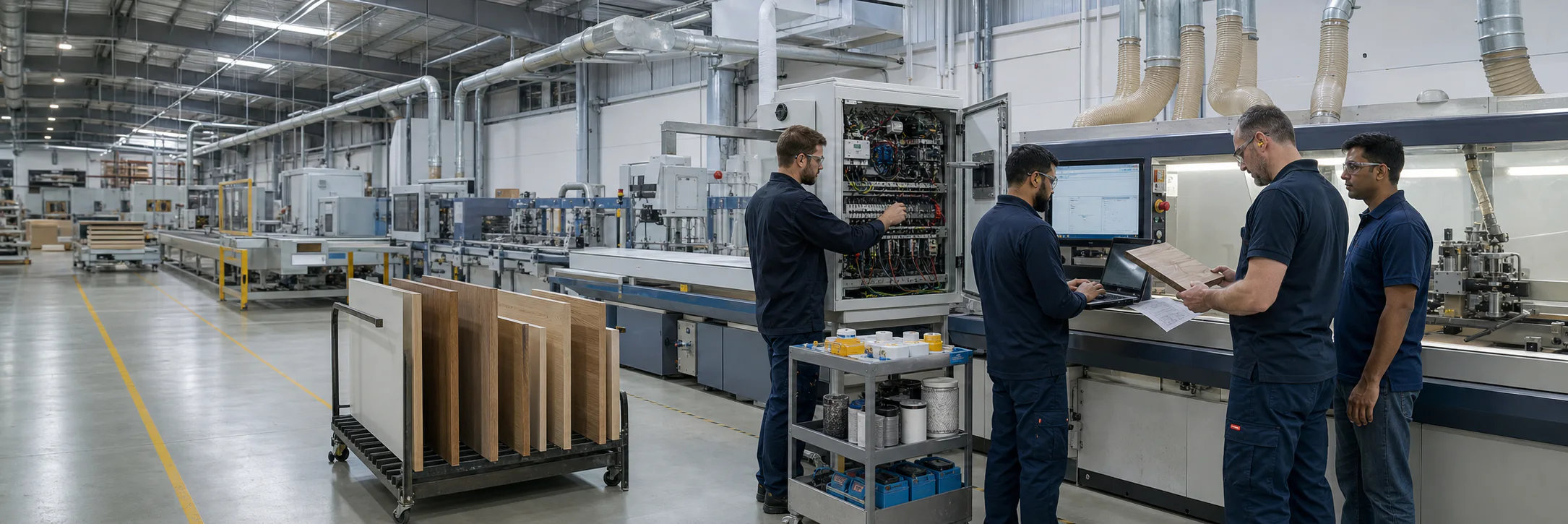
Zambeel established what was recoverable, then added the factory-engineering capacity needed to commission and transfer the equipment.
How engagements workThe requirement
The equipment had been acquired from several European factories and arrived in mixed condition, with operating interfaces and documentation in German or Danish. Regional OEM support was unavailable, and factory management needed the line brought to the point where staff could produce approved samples with confidence.
Faults ranged from routine wear and missing parts to damaged controls and obsolete components. The recoverability of each machine had to be established through inspection and testing.
Manuals, electrical information and machine records had to be traced, interpreted and organised before they could support diagnosis, maintenance or staff training.
Bringing a machine online was only useful if its throughput, consumables, maintenance needs and place in the factory workflow were also understood.
Commissioning strategy
Zambeel began with a complete machinery and documentation inventory, then established an active recovery sequence. When a machine required a part that had to be sourced or shipped, the team moved to the next system rather than allowing the overall programme to stop.
Machinery, documents, known faults, missing items and dependencies were organised into one operating picture before recovery work was sequenced.
Diagnosis, controls work, repair and part replacement progressed across multiple machines while long-lead spares were identified and sourced.
Machines were not treated as commissioned until operating behaviour and representative product samples had been checked with the factory team.
Recovery scope
The installation included panel cutting, edge finishing, machining, drilling, pressing, sanding and UV finishing equipment. Zambeel worked across mechanical, electrical and operating issues rather than separating commissioning into isolated repair tickets.
Wear, corrosion, damaged mechanisms and machine-specific shortcomings were identified, repaired where viable and recorded for future maintenance.
Industrial controls were diagnosed and repaired. On selected machines, control assemblies were recreated to the original functional specification.
Replacement components, sources, service intervals and recommended stock levels were established for spares, bonding agents, release agents and other consumables.
Minimum, maximum and preferred production rates were checked alongside representative door and wardrobe sample production.
Technical work
Used industrial equipment can consume time and parts without becoming dependable. The team distinguished viable restoration from repairs that would leave the factory with obsolete, structurally compromised or uneconomic machinery.
Each system was inspected under operation to identify damaged parts, alignment issues, wear, process limitations and the practical effect on output quality.
Power, protection, sensors, drives, control wiring and operator interfaces were traced and tested, with repairs or component replacement carried out as required.
Machines with irreparable corrosion or obsolete critical parts were documented as non-recoverable where custom recreation would cost more than moving to a newer replacement.
Operational handoff
The engagement continued through approved sample production so the handoff reflected real operating conditions. Documentation converted the team’s commissioning knowledge into maintenance, stock and operating information the factory could retain.
Machine-specific manuals recorded maintenance tasks, part life cycles, replacement intervals, known limitations and the faults identified during commissioning.
Spare-parts lists, supply sources and recommended stock levels were defined so routine wear or consumable demand would not repeatedly stop production.
Operators were trained in machine use, normal settings, throughput limits and routine care while producing samples that met the factory’s approval standard.
What changed
Most of the machinery was restored to operating condition, giving the factory a functional production line. Where corrosion, obsolete parts or replacement economics made restoration impractical, the affected machines were documented as non-recoverable.
The factory team produced approved door and wardrobe samples using the commissioned equipment, establishing that the recovered capability could support the intended products.
Regular production began later as commercial orders arrived, with the maintenance, parts, consumables and operating framework already in place.
Capabilities involved
The work required broad machine knowledge and enough production understanding to connect individual repairs to the factory’s intended output.
Machinery inventory, condition assessment, recovery sequencing, operating tests and production-readiness decisions.
ExploreControl-panel tracing, sensors, drives, protection, wiring repair, component replacement and OEM-specification recreation.
ExploreService procedures, life-cycle intervals, spare-parts sources, consumable stocks and known-condition records.
ExploreThroughput verification, sample production, operator training and documentation structured for continued factory use.
ExploreRelated work
We can help establish what is recoverable, restore dependable capability and transfer the operating knowledge to your team.