Controlled capture
Camera position, lighting geometry, reflections and physical presentation of the target had to produce inputs the vision teams could tune and trust.

Across three automotive quality-inspection and worker-support projects, Zambeel developed the physical systems that allowed vision-software teams to create controlled images, deploy models at workstations and collect evidence in real factory conditions.
Zambeel developed purpose-built hardware around client-owned software and provided a defined hardware workstream as the applications progressed.
How engagements workShared need
The underlying algorithms needed clear, consistently illuminated views of automotive surfaces, components or worker activity. Moving from that software requirement to useful equipment meant resolving lighting, imaging, compute, operator interaction and the constraints of each working environment together.
Camera position, lighting geometry, reflections and physical presentation of the target had to produce inputs the vision teams could tune and trust.
Each system also had to work around operators, factory routines, remote software updates and the practical limits of installation, maintenance and daily use.
Design approach
Rather than freeze one arrangement too early, Zambeel exposed the physical and electronic parameters the vision teams needed to test, tune and revise.
Camera and lighting parameters were made available to the software layer where remote tuning or changing models required it.
Camera stations, inspection equipment and wearable hardware were developed around the needs and constraints of each application.
Onboard and workstation compute, Ethernet, CAN and hardware interfaces were selected around the operational setting rather than treated as isolated electronics.
The three products
The shared requirement connected the work, but each product addressed a different inspection or worker-support need.
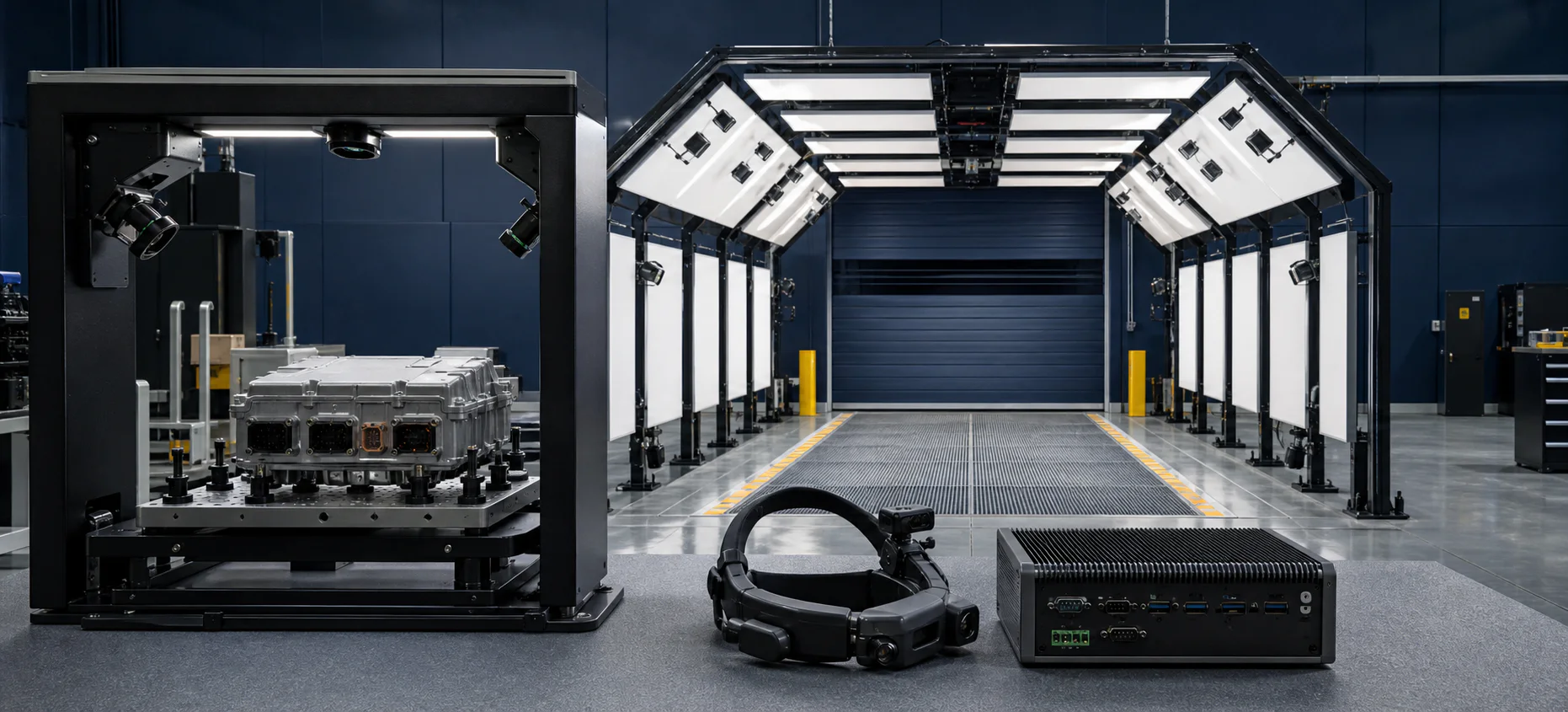
A sequence of camera and inspection-lighting platforms culminated in a walk-through tunnel for automotive final-assembly inspection.
Across approximately one year, Zambeel developed standalone camera posts, camera stations paired with zebra-pattern inspection panels, and a walk-through tunnel that integrated vision sensors and controlled lighting around the vehicle.
Camera and lighting arrangements were tailored as the inspection models developed, while physical trade-offs remained clear to the software engineers.
The completed tunnel gave the software company a working automotive-inspection demonstrator for model development and customer demonstrations.
A benchtop terminal presented completed automotive fuse boxes to the vision software, returned an immediate operator result and connected each inspection to the wider production environment.
A wear-resistant receptacle, controlled lighting and imaging tube, presence sensing and an eye-level display formed a robust workstation for repeated handling and clear acceptance or rework decisions.
Software-controlled imaging parameters, onboard compute and remote configuration allowed vision engineers to tune the system without returning to the factory. Zambeel trained the software company’s team to integrate the hardware and supported deployment remotely.
The terminal entered regular factory use. Vision engineers retained remote access for model updates.
A head-worn camera and haptic-feedback system provided a physical platform for evaluating real-time assembly-error prevention while workers performed normal factory tasks.
Zambeel moved vision processing to the workstation and streamed camera data wirelessly, reducing headset weight, heat and battery demand.
Lighting, batteries, wireless communication and haptic feedback were integrated into a full-day wearable designed for factory evaluation and data collection.
Ten wearable units enabled a vision-AI factory pilot. The hardware was used for data collection as development work for model training continued.
What changed
The inspection tunnel gave a software company a substantial demonstration environment it could use to develop its proposition and open conversations with further automotive customers.
The fuse-box terminal progressed into regular production use. In later discussions, the software team reported that supply rejections had become virtually non-existent because internally detected errors were no longer reaching the receiving inspection stage.
The wearable platform enabled pilot evaluation and data collection while making the remaining software-reliability problem explicit. This distinction protected the credibility of the hardware work without overstating the maturity of the complete solution.
Capabilities involved
The work connected imaging and algorithms to the physical interfaces, environments and operating patterns that determined whether each proposition could be demonstrated or used.
Lighting, imaging, sensing, compute, power, communication and mechanical architecture developed as complete systems.
ExploreOperator ergonomics, physical presentation of target components and wearable form developed around actual use.
ExploreCapture architecture, software-controlled parameters, datasets, network interfaces and deployment-aware compute decisions.
ExploreProgressive rigs, demonstrators, production equipment and pilot units used to resolve uncertainty at each stage.
ExploreRelated work
We can help determine what the algorithms need from imaging, hardware, operators and the operating environment.