Fragmented evidence
The available information had accumulated across teams, contractors and phases. Claimed tests, technical documents, requirements and physical prototypes did not yet form one organised, traceable body of evidence.

A software product company needed a defensible picture of completed work, unresolved risk and the route from inherited prototypes toward retail production.
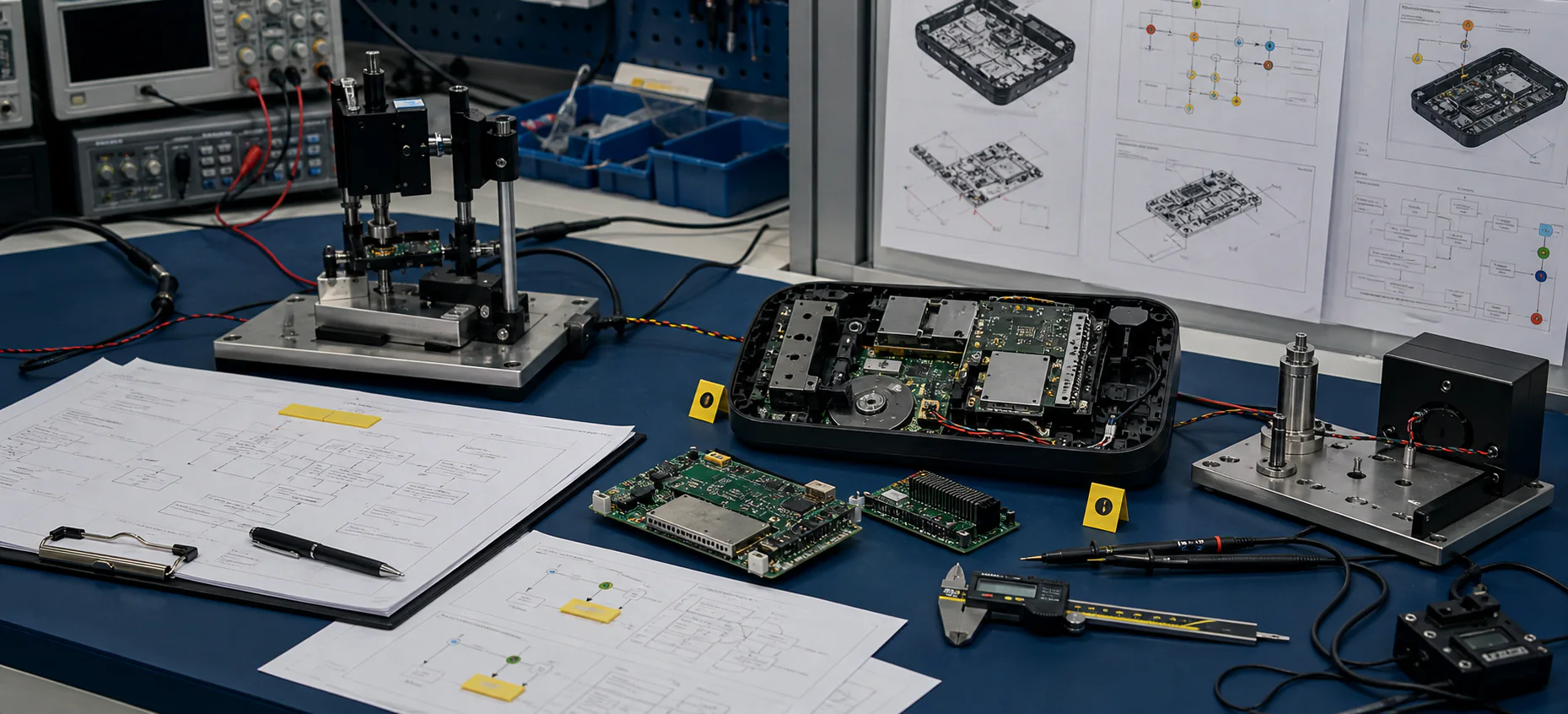
Zambeel provided an independent technical position on an inherited hardware programme so management could resolve the current phase and decide what should happen next.
How engagements workThe situation
The programme was intended to give users of a software product dedicated, closely integrated consumer hardware. After a change in management, the company needed to understand whether the current development phase had actually met its obligations and what remained between the available prototypes and retail production.
The available information had accumulated across teams, contractors and phases. Claimed tests, technical documents, requirements and physical prototypes did not yet form one organised, traceable body of evidence.
Management did not need another design opinion in isolation. It needed a fair technical position that could support immediate decisions while protecting continuity if the development arrangement changed.
The uncertainty
Zambeel first organised the programme information into a structured data room, then formed coordinated electronics, mechanical and user-experience review workstreams.
Contracted requirements, product documents and submitted deliverables were cross-referenced to establish coverage, omissions and inconsistencies.
Available test records were checked, missing validation was identified and the evidence was compared with applicable standards and development-stage expectations.
The review established whether the company held enough information to continue the programme if the existing contractor could no longer do so.
Physical verification
A Zambeel team examined and tested the delivered hardware at the client’s site. Findings were recorded through test videos and annotated photography, then referenced back to agreed requirements and the contractor’s submitted material.
The assessment documented issues requiring correction alongside deliverables that met the expected standard. This distinction mattered: the objective was to establish a technically fair position, not to justify a predetermined commercial outcome.
Risks in the product and in the way development had been conducted were separated from one another. Management could therefore see which concerns belonged to the current phase and which would affect the route to commercial production.
Assessment outputs
The final body of work gave different audiences the level of detail they needed while preserving traceability back to the underlying evidence.
Organised project information, missing material and continuity requirements.
Workgroup findings covering mechanical, electrical, electronics and user experience.
Videos, annotated images and findings cross-referenced to agreed requirements.
A concise board-level view of status, risk, options and the route forward.
What changed
Using the assessment, management and the contractor held a focused review of the current phase. The contractor considered the findings fair, agreed to the necessary repair and rework, and made clear where some requested items could not be completed.
A new phase of work was formed around a revised roadmap. The client retained a workable development path rather than having to choose between accepting unclear progress or abandoning the programme.
The assessment led to continued engagement for consultancy and supervision, followed by further hardware projects.
Capabilities involved
The programme could only be assessed credibly by connecting documentation and commercial milestones to the physical condition and technical maturity of the product.
Independent assessment, programme risk, contractor deliverables and the route toward commercial production.
ExploreMechanical, electrical and electronics review across one connected product architecture.
ExplorePhysical inspection, functional testing, missing validation and evidence quality.
ExploreUser experience, product requirements and readiness for continued development.
ExploreRelated work

Share what has been delivered, what remains unclear and the decision the evidence needs to support.