Luminous efficacy and output density
Lumens per watt determined electrical efficiency, while luminous flux per unit emitter area determined whether the target output could fit into a device that could still be carried and aimed.

A technology investor needed a high-output portable light to market a new lighting brand. Zambeel developed the prototype around a 100,000-lumen design target, balancing luminous efficacy, output density, thermal performance, battery mass and safe demonstration use.
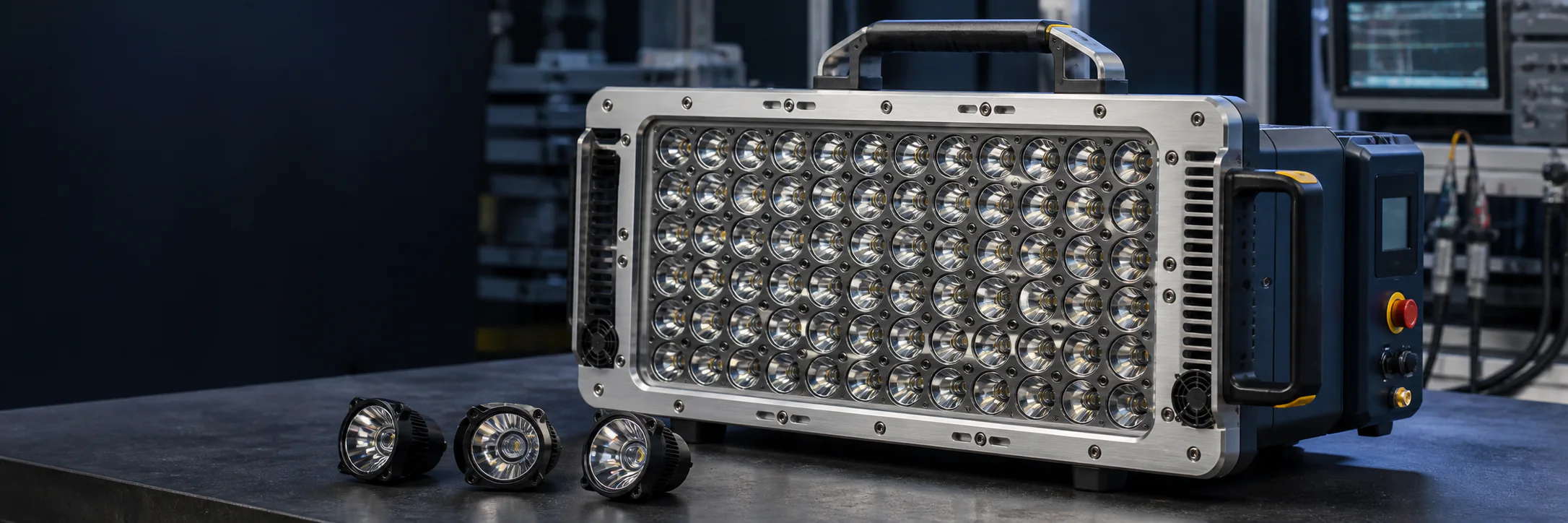
Zambeel owned the coupled optical, thermal, power, control and prototype work required to deliver the demonstrator.
How engagements workThe requirement
The client was preparing a new premium lighting brand and wanted a high-impact demonstrator ready for a marketing event. The brief set a 100,000-lumen target while asking Zambeel to find a workable balance between light intensity, operating time, heat and total weight.
Lumens per watt determined electrical efficiency, while luminous flux per unit emitter area determined whether the target output could fit into a device that could still be carried and aimed.
The demonstrator had to be designed, manufactured, integrated and tested within two months so it could take part in the planned event.
System architecture
Increasing any one performance figure affected the others. Zambeel iterated the physical architecture around the peak demonstration condition and a lower-power operating mode suitable for repeated public use.
The emitter layout was developed around power efficiency and output per unit area while retaining a manufacturable assembly.
A thin, wide aluminium heat sink used internal forced-air channels to spread and remove heat without allowing the plate to warp.
Battery capacity and output modes were coordinated to support both peak illumination and longer routine demonstrations.
Temperature sensing, automatic dimming and controlled peak-mode access reduced the risk of misuse during events.
Thermal engineering
Local hot spots or uneven cooling could reduce LED life and distort the plate. Zambeel developed a two-layer aluminium heat sink with internal air channels, manufactured through a combination of CNC machining and EDM before the layers were assembled.
Iterations examined temperature distribution, airflow and the relationship between plate thickness, channel geometry and sustained operating conditions.
An array of contact temperature sensors was used during development, supported by non-contact measurements and repeated physical tests.
The delivered product featured temperature sensors at key locations across the plate, allowing its controller to respond to actual thermal behaviour.
Controls and validation
The final prototype weighed 7 kg. It could operate at peak output for approximately one minute, while its normal demonstration mode ran for about 15 minutes at roughly one-quarter to one-fifth of full power.
Output reduced progressively as measured temperature approached the operating limit instead of relying only on a binary thermal shutdown.
Remaining battery capacity informed the available operating behaviour, helping the demonstration team manage repeated use.
Electrical, thermal, mechanical and functional testing was carried out before delivery, including repeated operation under demonstration conditions.
Second development phase
A single lens large enough for the complete plate would have been impractical. Zambeel instead developed separate reflector geometries for LED clusters positioned at different distances from the centre, directing their outputs into one approximately 30-degree beam.
Reflector angles varied across the plate so light from different positions converged into the intended common beam rather than diverging as separate flood beams.
The custom reflectors combined carbon-fibre-reinforced nylon outer bodies with silvered reflective interiors and accommodated collimating lenses within the available space.
The completed modification was measured using alignment methods employed for automotive headlamps and then demonstrated successfully at the client’s event.
What changed
The first prototype was completed in two months and used successfully at the planned marketing event. It continued to operate at later events.
The second engagement converted the existing broad light source into a narrower, measured beam without replacing the original thermal and power platform.
Together, the projects demonstrated Zambeel’s ability to turn an ambitious performance target into a testable physical system, then solve a later constraint through purpose-built optics and manufacturing methods.
Capabilities involved
The work moved between analytical design and physical iteration, with each discipline constrained by the same portable enclosure and event deadline.
Emitter density, collimation, cluster reflector geometry, beam formation and physical alignment measurements.
ExploreHeat-transfer simulation, internal air-channel design, temperature instrumentation and operating-envelope validation.
ExplorePower architecture, temperature-proportional dimming, battery-aware operation and protected demonstration modes.
ExploreCNC and EDM heat-sink manufacture, composite reflector production, silvered surfaces, integration and comprehensive testing.
ExploreRelated work
We can help turn an ambitious physical brief into a credible development programme, working prototype and validated operating envelope.