Work/Case study

Mobile propulsion test bed

An aerospace design team needed testing capacity as part of a time-sensitive programme milestone. Zambeel designed and delivered a towable, self-contained test bed that could travel between available test locations and support the development work leading to that milestone.

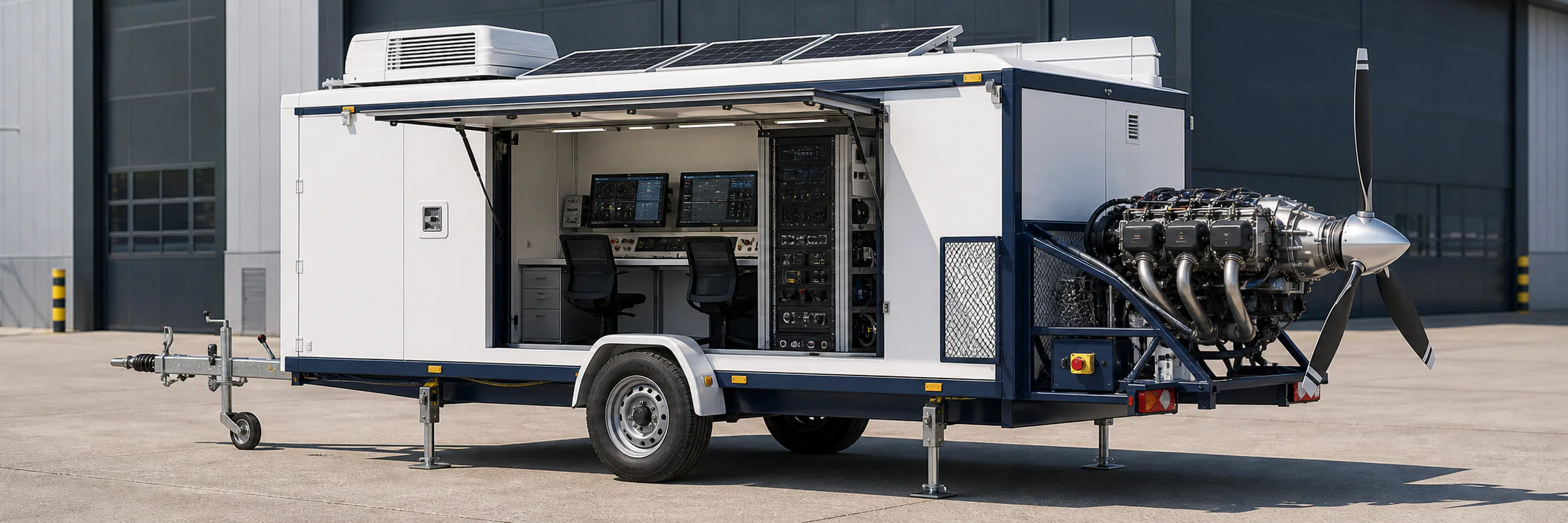
New conceptual render of a compact single-axle mobile engineering cabin with a rear-mounted flat-six engine and a three-blade, aft-facing propeller
Conceptual design visual representing the test-bed configuration. It does not depict the client system or Zambeel’s original design.
Client contextAerospace design team
EngagementSystems engineering and integration
DeliveryCompleted in 75 days
OutcomeTesting capability for the milestone
Engagement routeDevelop

Zambeel led the design, engineering, fabrication coordination and integration of a complete physical test bed against a time-sensitive milestone.

How engagements work

The design team had a time-sensitive milestone, but not the available internal capacity to reach it.

The client was developing an efficient propeller propulsion system. Its workshops and engineering resources were committed to production and regular operations, so development of the required test bed would repeatedly move behind higher-priority internal demand.

Time-sensitive programme milestone

The client had five months to demonstrate a working prototype to corporate management and investors. A large part of the testing and development required for that milestone could begin only after the completed test bed had been handed over, so Zambeel’s delivery window was substantially shorter.

No dedicated test area

Suitable sheds and outdoor areas were spread across locations that required road travel between them and became available at different times. A fixed installation would have created another scheduling dependency, so the test bed needed to be genuinely mobile.

The delivery questionHow could a complete mobile test bed be designed, integrated and handed over early enough for the aerospace team to complete the testing-dependent development work before its milestone?

The workstreams had to proceed in parallel without creating problems at final integration.

Zambeel provided an expedited engagement and organised requirements, design and fabrication around shared interfaces. Chassis, cabin and systems work advanced concurrently while design decisions were still being resolved.

Definition

Requirements settled early

Zambeel worked directly with the client to define test use, mobility, workspace, safety and operating constraints before they could become late-stage fabrication changes.

Coordination

Interface-led development

Structural, cabin and systems teams worked from coordinated physical, electrical and mounting interfaces rather than waiting for one discipline to finish completely.

Delivery

Completed in 75 days

The completed test bed was handed over in 75 days, preserving time inside the client’s five-month demonstration window.

The test bed became a mobile engineering environment, not only a mounting frame.

A towable enclosed cabin allowed the client to relocate between available test areas while keeping the propulsion interface, control and data-acquisition systems, power and engineering workspace together.

Instrumentation

Integrated engine data system

The rear-mounted engine was integrated with commercial engine-control avionics, performance sensors and a dedicated data-acquisition system, providing one system for engine operation and performance-data collection.

Engineering use

Conditioned workspace

Air conditioning and internal workstations gave the design team a controlled place to monitor tests and work alongside the equipment.

Independent power

Battery and solar support

Onboard battery backup and solar generation reduced dependence on the local utilities available at each temporary test location.

Safety

Emergency provisions

Emergency shutdown, fire-safety measures and protected equipment arrangements were incorporated into the test-bed design.

Instrumentation, mobility and structural behaviour had to remain one design problem.

The test bed combined an aerospace propulsion interface, instrumentation and an occupied workspace within a road-transportable structure. Zambeel developed the enclosure and systems around the operating loads, road vibration, weight distribution and working conditions created by that combination.

Instrumentation and data acquisition

Commercial aerospace instrumentation captured temperature at multiple points, prop-shaft torque and noise. Zambeel’s role covered integration of the sensors, engine-control avionics and data-acquisition equipment rather than development of the propulsion control system itself.

Mechanical and structural

Structural analysis, vibration assessment and weight estimates informed the single-axle chassis, cabin, rear engine structure and equipment distribution for both engine operation and road transport between test locations.

Electrical and systems integration

Instrumentation and avionics wiring were coordinated first, then integrated with cabin services, battery and solar backup, safety equipment and the overall power architecture.

Parallel delivery succeeded because integration was designed before final assembly.

The chassis, cabin and systems fabrication teams completed separate workstreams that came together without corrective integration work. Once the complete test bed had been integrated and verified, it was handed over with the drawings and documentation required for operation, maintenance and future reproduction.

Physical integration

Mounting geometry, access, service routes and equipment positions were coordinated across the structural and cabin designs before the final build converged.

Operational readiness

The test bed was handed over ready for use, with safety provisions, instrumentation, working space and independent utilities in place.

Reproducible design

The design package later enabled the client’s test rig fabrication team to reproduce the test bed for use elsewhere in the factory.

The client gained testing capacity in time for the milestone and retained it for later programmes.

The aerospace team completed the demonstration milestone it had set for management and investors.

The test bed has remained in use for several years, supporting further engine and propeller development beyond the original propulsion programme, including work by other teams inside the company.

The client’s test rig fabrication team later reproduced the test bed for use elsewhere in the factory, extending the value of the design beyond the expedited first build.

Fast systems delivery across structures, instrumentation and mobile infrastructure.

The project required Zambeel to maintain design control and integration while several engineering and fabrication streams advanced concurrently within a compressed delivery window.

Technical Definition and Systems Planning

Requirements, test use, mobility, safety, workspace and interface definition organised around the client’s milestone.

Explore

Mechanical and Structural Engineering

Chassis, cabin, propulsion mounting, structural analysis, vibration assessment and weight distribution.

Explore

Electrical and Systems Integration

Instrumentation and data acquisition, avionics and sensor wiring, power architecture, backup systems, HVAC and emergency provisions.

Explore

Prototype Manufacturing and Handoff

Parallel fabrication coordination, final integration, functional delivery and reproducible design documentation.

Explore

Other programmes shaped around demanding physical operating conditions.

Discuss a requirement

Bring us the milestone, the test objective and the operating constraints.

We can help define and deliver the physical systems your internal team needs to keep a development programme moving.

Tell us what you need